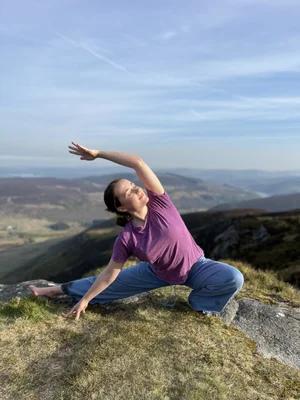
Week Three - Pingala Nadi, The Sun Channel
Hello everyone,
I can't believe it, we are almost half-way through our winter yoga term! Thank you so much to each of you who made it for our moon themed yoga flow last week, where we moved in honour of ida nadi, the energy channel in the body associated with lunar qualities and the parasympathetic nervous system. It was a gentle hip and heart opening flow, designed to invite a sense of calm and softness. I don't know about you, but winter time always speaks to me like ida nadi - the slothful temptation to draw inward, reorientate myself towards introspection, and let go of what's gone while guarding space for new blessings to take root.
Despite this cosy inclination of winter (!), we will seek to find energetic balance this Sunday in class with an exploration of pingala nadi; the solar energy channel. You can expect an invigorating, enlivening hatha practice this week (still all levels friendly!) where we'll build mindful heat, cultivate a powerful breath, and release pent-up stress with strong yoga asana (poses) before settling blissfully into a stretchy relaxation sequence and restorative savasana. This 'sun' themed yoga practice is such an important one to do in the winter time. You can read more on why that is below...
There are a small handful of drop-in spaces available for hatha this Sunday at Thrive Greystones, if you'd like to join! You can send me a message here to save your space :) I am also taking early-bird bookings/inquiries for the new Sunday Yin Yoga term beginning in January 2026 - a softer, stretchier yoga practice - if you'd like to get your name in early for that :)
Now, for a little more information about pingala nadi - sun channel - if you're interested. As we've been learning, in yoga tradition a nadi is seen as a channel of energy within the subtle non-physical body (sukshma sharira). There are said to be over 72,000 in every one person, but we are focusing on just the primary three this term. While a nadi is indeed a non-physical awareness, two of the primary nadis are incredibly well-linked to our modern observations of the brain and the nervous system, and how everything connects.
For example, within our autonomic nervous system we have what's called a sympathetic state, and a parasympathetic state. When activated, the sympathetic nervous system (linked to pingala nadi) allows our body and mind to function well under stress or danger: our energy soars as adrenaline floods our system, our blood flow re-directs to our muscles, pupils dilate so that we can see better and react faster, our breath quickens, and non-essential functions like digestion are suppressed to conserve energy. This is an essential ability of our body to adapt, and when under control, the sympathetic nervous system can help us to feel really healthy and in balance.
The sympathetic nervous system is of course naturally balanced with the parasympathetic nervous system, which is our 'rest and digest' state. They're almost like two rivers running alongside each other - which is what the yogis saw when they became aware of these two primary nadis. The 'rest and digest' parasympathetic state (linked to ida nadi) is when our body calms down because we feel safe; our breath deepens, our non-essential physical functions like fertility and digestion restart, and we begin to relax and feel more creative; even more socially connected. (p.s. a lot of people come to yoga for this!)
When we say that our nervous system has a 'rest and digest' and 'fight or flight' state - one sounds good, and the other sounds bad, doesn't it? A lot of wellness media says that we should seek calm and relaxation over all else. Find ways to regulate our nervous system. Soften. Let go. Who wants to be stressed out and anxious all the time? Why, then, would I intentionally activate my sympathetic nervous system with a sun themed pingala nadi practice?
The truth is, it's about balance. The yogis knew this. Chronic stress is awful, but if ida nadi and the parasympathetic nervous system ('rest and digest') are overly active and dominant in the body, things quickly fall out of flow - just in the other way. We can experience lethargy. Laziness. Stagnancy. Depression. Even a freeze response when under pressure or stress. In my family home there is a magnet on the fridge that says: 'my get up and go has got up and gone.' - this is not an ideal feeling if you want to live a life that is alive, resilient, and in alignment.
It turns out that activating the 'fight or flight' system in our body can be a really good thing, in small doses. There is a fascinating biological phenomenon called hormesis that occurs when we intentionally expose ourselves to short-term stress. Rather than causing harm (like if we are constantly experiencing high stress), low-dose exposure to stress actually strengthens our cellular body and re-wires our relationship to challenge. This is why physical exercise and experiences that excite and challenge our body can be one of the best ways to regulate our nervous system, in that it allows us shift and unblock our energy flow momentarily so that when we do relax back into a parasympathetic state we don't feel as stuck or stagnant. We feel satisfied, inspired, and ready for anything. Sort of how the sun gets high in the sky each day before it sets...and rises...and sets again...
That's all from me! Sending lots of light to you this week :)
And still,
after all this time,
the sun has never said
to the Earth, 'You owe me.'
Look what happens with a love like that.
It lights up the sky.
Rumi.
Le grá,
Macha